
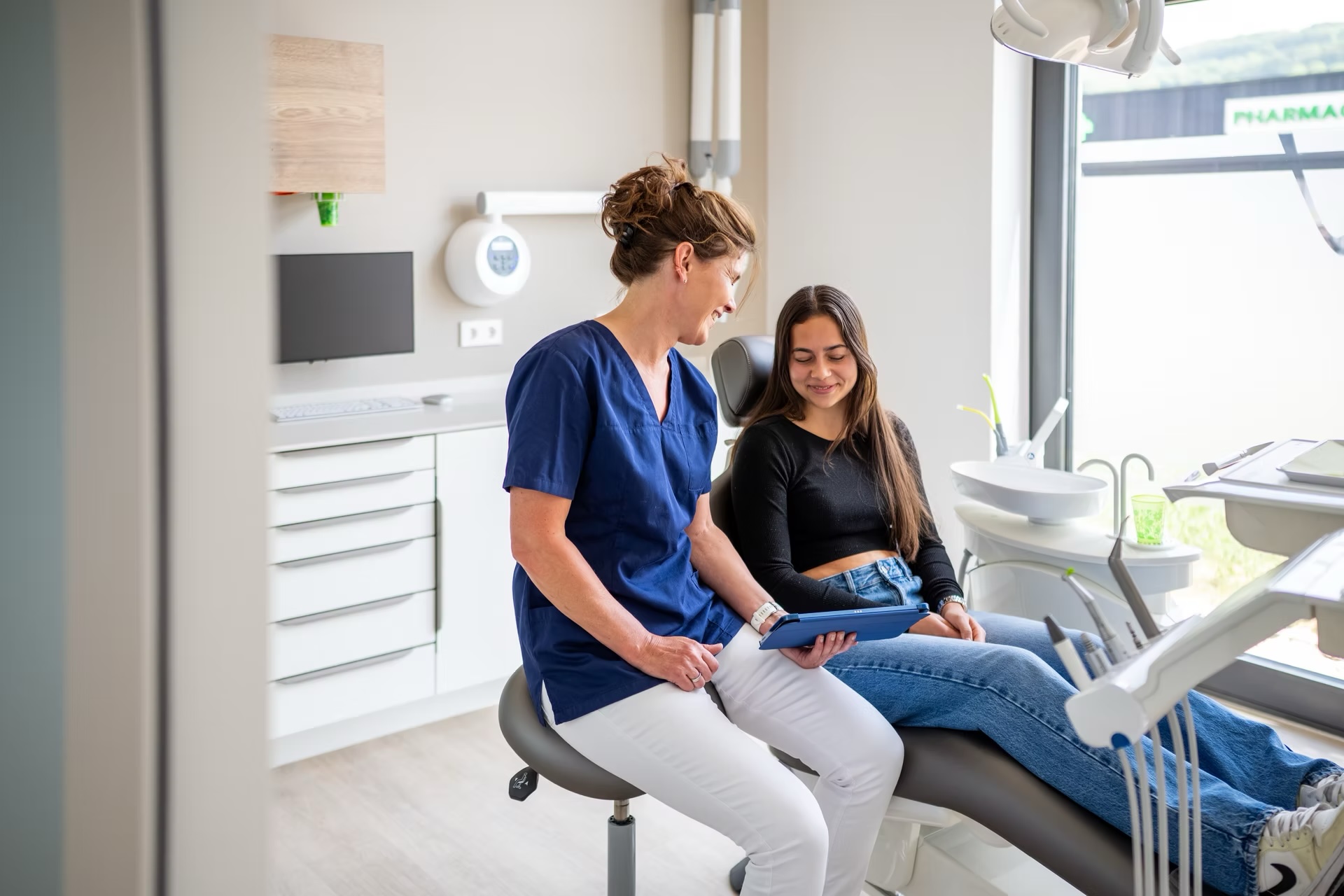
The First Appointment – Pediatric Dentistry
At this appointment, we assess your child’s condition and evaluate their ability to cooperate. The goal is to get to know your child and help them get to know us, building trust to make treatment possible. You can positively influence your child in advance by using mindful and positive language. Avoid phrases with “not,” such as “It won’t hurt” or mentioning “needle.” During the treatment, whenever possible, please leave the guidance of your child to us.
Pediatric and Adolescent Dentistry
Based on a thorough diagnosis, we individually evaluate which treatment is most suitable for your child and aligns with your preferences. Our range of services covers all aspects of modern pediatric and adolescent dentistry, guided by the latest international standards:
- Prophylaxis for healthy teeth and a bright smile – including toothbrushing instruction, professional dental cleaning, fissure sealing, and enamel strengthening measures.
- Fillings made of composite or cement.
- Pediatric crowns for severely damaged teeth, available in silver or white. Silver crowns offer the best long-term prognosis, while white crowns require more effort.
- Primary tooth endodontics for deeply decayed teeth.
- Pediatric prosthetics and space maintainers after early loss of primary teeth, enabling carefree chewing, speaking, and smiling.
- Removal of restrictive lip and tongue ties.
- Treatment of MIH (“chalky teeth”).
- Aesthetic corrections of front teeth, such as removal of spots caused by trauma, MIH, bracket removal, or fluorosis.
- Front tooth trauma – we have an emergency contact number to ensure availability on weekends or evenings, as time is often critical to preserve permanent teeth.
- Nitrous oxide sedation via a scented nasal mask. This method helps your child feel relaxed, reducing fear, pain sensitivity, and the gag reflex. It is a very safe calming method, with effects wearing off quickly.
- Treatment under general anesthesia after careful evaluation, conducted at CHEM in Esch-sur-Alzette.
The First Appointment – Orthodontics
As a general rule, it makes sense to schedule the first consultation around the age of 8–9 years. This allows us to determine early on whether treatment will be necessary or is already indicated.
In rare cases, earlier treatment is important to avoid negative effects of malocclusions on the growth of the jaws and face. Therefore, you should take your child to the dentist regularly.
At the first appointment, we will first carry out a thorough examination of the teeth, dental arches, jaws, and functional conditions. We then discuss whether orthodontic treatment is recommended and, if so, how it would proceed. We will take time to answer all your questions during this initial visit.
Treatment Planning – Orthodontics
Before treatment begins, diagnostic records are prepared (x-rays, jaw models, photos, and a functional examination), forming the basis for an individually tailored treatment plan – ensuring effective and personalized orthodontic care. We will then discuss the treatment plan and possible alternatives with you.
The range of treatments includes:
- Early orthodontic treatment from around 5 years of age (using removable or fixed braces).
- Treatment with removable braces – the appliance can be inserted and removed by the patient. Regular independent activation at home is usually required. Not all malocclusions can be treated with removable braces.
- Treatment with a multi-bracket appliance (“fixed braces”) – since it is worn continuously, it works around the clock and is therefore an effective method for almost all malocclusions. It is generally used once all permanent teeth have erupted and requires excellent oral hygiene.
- Combined orthodontic-surgical treatment – in rare cases of severe jaw malpositions, correction is only possible through a combination of braces and surgery.
- Special prophylactic measures during fixed appliance treatment to ensure teeth not only become straight but also remain healthy: instructions for proper cleaning, monitoring of oral hygiene at check-ups, application of smooth surface sealants, and more frequent professional cleanings during fixed treatment.
- Temporomandibular joint diagnostics and treatment of TMJ disorders.
- Stabilization – after the “active phase,” in which teeth are moved, they must be maintained in their new position, usually with a fixed retainer behind the incisors (invisible) and additionally with removable braces or aligners.